


The Evolution and Modern Appeal of Public Golf Courses
Whether you are chasing a personal best on a championship layout or simply looking to refine your swing mechanics after work, the modern golf experience is changing. Today, the gap between elite private clubs and accessible public courses is narrower than ever. We are seeing a new era where top-tier course design meets cutting-edge training tools, allowing players of all levels to enjoy the game more than ever before.
In this guide, we explore how premier public golf destinations are elevating the player experience. We will dive into the rise of world-class course architecture and examine how integrating golf lessons indoor has become a game-changer for consistency. By blending traditional outdoor play with high-tech performance centers, these facilities provide a comprehensive path to improvement that fits into even the busiest schedules. Whether you are looking to master your short game or sharpen your driver, understanding how to utilize these modern resources is the key to unlocking your full potential on the course.

The modern public golf course is no longer just a place to play 18 holes; it has evolved into a comprehensive hub for athletic development and social engagement. In the past, high-quality course conditioning and advanced coaching were often reserved for exclusive private clubs. Today, premier public venues are leveling the playing field, providing championship-caliber turf, sophisticated practice facilities, and professional instruction to anyone who loves the game. Municipalities and independent operators alike recognize that investing in high-standard agronomy and modern training infrastructure builds vibrant, dedicated golf communities.
Accessible Championship Layouts on Modern Public Golf Courses
Public courses are increasingly focusing on “tournament-ready” conditioning. By investing in advanced irrigation, specialized grass varieties like hybrid Bermudagrass and modern bentgrass strains, and strategic bunker placement, these facilities ensure that every golfer experiences a fair but challenging test of skill. The beauty of these layouts lies in their versatility. With multiple tee boxes, a single course can cater to a scratch golfer looking for a rigorous challenge and a beginner seeking a more approachable experience.
Furthermore, the focus on “pace of play” and strategic design—such as wide landing zones paired with guarded greens—encourages better course management. When you play at a facility that prioritizes the golfer’s experience, you learn to think your way around the course rather than just swinging away at every hole. Modern course architects design angles that reward smart positioning over sheer distance, making public courses both tactically stimulating and deeply enjoyable.
Integrating Advanced Practice Facilities and Year-Round Training
The most significant shift in public golf is the integration of high-tech practice areas. The traditional driving range is being replaced or augmented by performance centers that allow for data-driven improvement. These facilities now offer comprehensive indoor training environments, allowing players to work on their swing even when the sun goes down or the weather turns poor. By utilizing these indoor resources, golfers can maintain their muscle memory throughout the year, ensuring that the first round of the spring isn’t spent “re-learning” the fundamentals. The marriage of classic course play and innovative practice structures guarantees a complete ecosystem for golfer development.
Bridging Outdoor Play and Indoor Training Technologies
The transition from the driving range to the simulator bay is one of the most effective ways to accelerate your development. While outdoor practice allows you to see the ball flight in its natural environment, indoor simulators provide the precise data needed to diagnose what is actually happening at the moment of impact.
| Feature | Outdoor Range Practice | High-Tech Indoor Simulator |
| Data Feedback | Visual (subjective) | Numerical (objective) |
| Environment | Natural wind/light | Climate-controlled |
| Repetition | Moderate | High (30 mins = 90 mins) |
| Focus | Ball flight observation | Swing mechanics/metrics |
Analyzing Swing Mechanics with Launch Monitors and Simulators
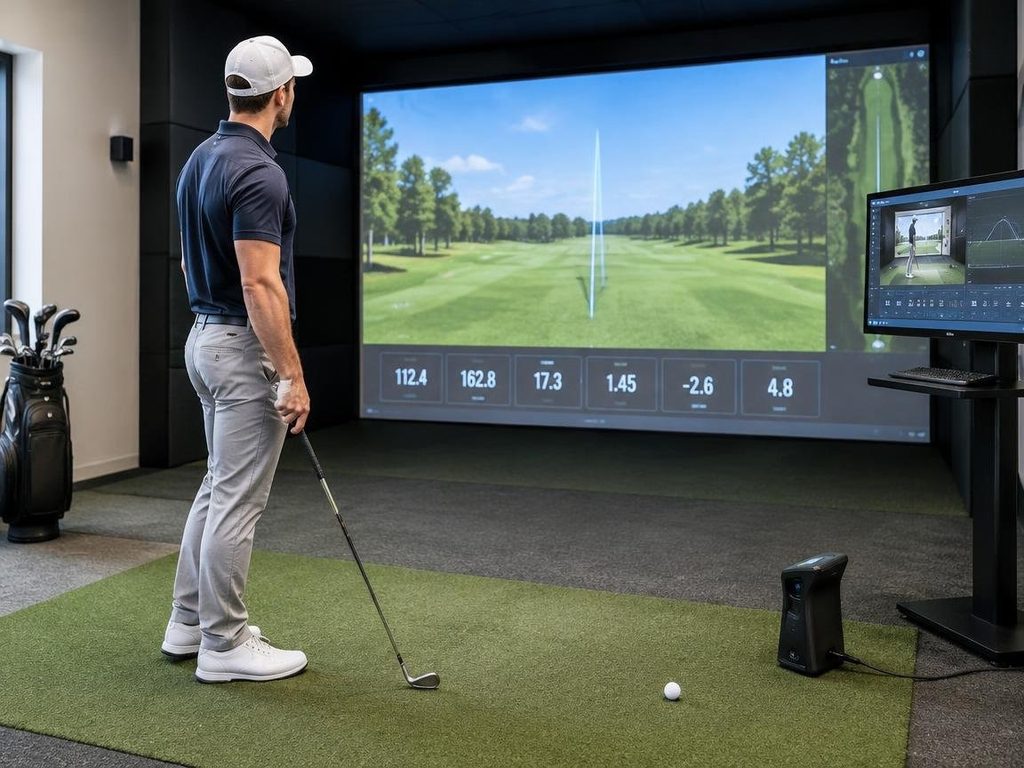
When you engage in a session with a launch monitor, you are essentially looking under the hood of your swing. These devices capture critical metrics such as club path, face angle, spin rate, attack angle, smash factor, and launch angle. By reviewing this data, you can move past the guesswork of “feeling” a good shot and start understanding the physics behind it. For instance, if you are consistently slicing the ball, the simulator will show you exactly how much your club path is moving outside-in relative to your face angle, allowing you to make micro-adjustments that lead to immediate, measurable results.
High-speed optical sensors and radar units also measure dynamic loft and closure rates, pinpointing whether a miss comes from poor delivery or off-center contact. This diagnostic precision eliminates wasted range balls and builds concrete confidence in your swing mechanics before you step onto the first tee.
Enhancing Short Game and Putting Precision
Perhaps the most underrated advantage of modern indoor facilities is the attention paid to the short game. Augmented reality putting greens and high-speed camera tracking are revolutionizing how we practice the “scoring” part of the game. These systems project lines directly onto the turf, showing you the exact break, apex, and speed required for a putt. Optical trackers evaluate face angle at impact and skid distance to ensure pure roll. This takes the mystery out of reading greens and helps you develop a consistent, repeatable stroke that you can take directly to the outdoor course, turning high-pressure par saves into routine taps.
Player Development Pathways Across Skill Levels
Instruction has moved beyond the “one-size-fits-all” model. Today’s premier facilities offer structured programs that cater to the specific needs of the individual, whether they are picking up a club for the first time or trying to shave a few strokes off a single-digit handicap.
Structured Coaching and Junior Academies on Public Golf Courses
Junior development is the lifeblood of the game, and modern public facilities are investing heavily in the next generation. By keeping student-teacher ratios low and incorporating game-based learning, these academies ensure that children develop a love for the game while building a solid technical foundation. These programs often emphasize motor skills, etiquette, course management, and the rules of golf, providing a holistic education that goes far beyond just hitting balls. By establishing progressive skill benchmarks, young players experience tangible milestones, creating long-term passion and athletic growth.
Comprehensive Swing Assessments and Tailored Practice Plans
For adults, the journey usually begins with a baseline assessment. By recording your swing on multi-angle high-speed cameras and comparing it against your launch monitor data, instructors can build a personalized practice plan. This might include specific drills to improve your transition, kinematic sequence adjustments to boost clubhead speed, exercises to increase your rotational power, or a custom club fitting to ensure your equipment is working for you rather than against you.
Furthermore, coaches use statistical gap analysis to discover where strokes are actually being lost on the course. Whether the issue is poor driver dispersion or inconsistent wedge distance control, a structured plan eliminates aimless practice and accelerates real-world improvement on the scorecard.
Optimizing Performance Through Year-Round Consistency and Golf Fitness
Consistency is the ultimate goal in golf, but it is notoriously difficult to achieve if you only practice during the summer months. The ability to practice in a controlled, weatherproof environment is a massive advantage for any golfer serious about improvement.
Weatherproof Practice and Repetition Density
One of the most compelling statistics in modern golf is that 30 minutes in a high-tech indoor bay can provide the same number of quality repetitions as 90 minutes on a traditional range. Because you don’t have to chase balls, wait for the range picker, or battle the elements, you can focus entirely on your swing mechanics. This “repetition density” is essential for building the muscle memory required to perform under pressure on the course. Winter and rainy-day training sessions prevent the skill decay that historically troubled golfers during the off-season, ensuring continuous forward momentum.

Integrating Physical Conditioning and Biomechanics
The modern golfer is an athlete. Recognizing this, many top-tier public facilities have integrated physical conditioning into their training programs. By working on core stability, thoracic spine mobility, and lead hip internal rotation, you ensure that your body is physically capable of executing the swing changes your coach is recommending. Ground reaction force training and rotational speed work translate directly into distance off the tee without sacrificing balance. This focus on biomechanics not only improves your performance but also plays a critical role in injury prevention, keeping lower backs and joints healthy so you can enjoy the game for decades to come.
Frequently Asked Questions About Public Golf and Modern Training
How do modern public golf facilities compare to private clubs in amenities?
The gap is closing rapidly. Many public facilities now offer high-tech simulators, professional-grade practice greens, certified club-fitting studios, and even on-site fitness areas. While private clubs offer exclusivity and member traditions, modern public courses focus on accessibility, providing championship-level conditions and tournament-grade technology to a wider audience at transparent rates.
What are the main benefits of combining simulator sessions with on-course play?
Simulator sessions provide the objective data needed to fix mechanical flaws, evaluate ball strike consistency, and dial in yardages, while on-course play allows you to test those changes in a real-world environment featuring varying lies, wind conditions, and pressure situations. This continuous “feedback loop” is the fastest way to bridge the gap between practice breakthroughs and real scoring.
How does data tracking technology accelerate game improvement for beginners?
For a beginner, the game can be overwhelming because traditional ball flights don’t immediately explain the root cause of an error. Data tracking simplifies this by turning complex movements into clear, actionable numbers like face angle and swing path. Instead of wondering what went wrong, you can look at the screen and see exactly what happened, creating a much faster, clearer, and more rewarding learning curve.
Conclusion
The landscape of golf is shifting toward a more inclusive, data-driven, and accessible future. By taking advantage of the premier public courses available today, you gain access to the same tools and training methods once reserved for the professional elite. Whether you are utilizing the latest in simulator technology to refine your swing or working with a coach to build a long-term development plan, the resources at your disposal have never been better.
We encourage you to explore the facilities in your area, embrace the technology, and commit to a consistent practice routine. When you combine the beauty of a well-maintained outdoor course with the precision of modern indoor training, you aren’t just playing golf—you are mastering it.
